Are eggs good for your heart? Let’s crack the truth
For decades, the humble chicken egg has been at the center of an intense dietary debate. At times, it has been celebrated as an affordable, nutrient-dense superfood capable of powering muscle growth and sharp cognitive function. At other times, it has been cast as a dietary villain, heavily scrutinized for its high internal content of lipids and organic compounds.
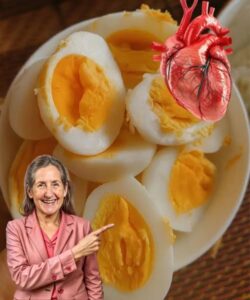
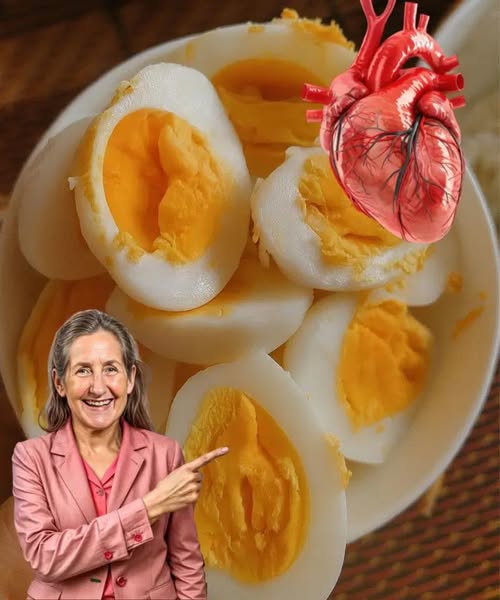
This conflicting status leaves many everyday individuals confused. If you look at the social media post displayed, the caption reads: “Doctors say eggs can do more inside your body than most people realize…” The image features a bowl of hard-boiled eggs with a human heart superimposed over them, alongside a medical professional pointing directly toward the yolk. This visual clearly implies a powerful, direct connection between daily egg consumption and cardiovascular health. But what does modern clinical science actually say? Does consuming this whole food protect your cardiovascular system, or does it elevate internal risks?
To truly understand how this food impacts the human body, we must look past sensational social media graphics and dive into the deep biochemistry of the yolk and white, exploring how the human body metabolizes its complex components.
The Nutrient Architecture: What is Inside a Whole Egg?
To evaluate the impact of this food on human physiology, we must first break down its nutritional matrix. A single large, whole egg serves as a bio-encapsulated package designed by nature to sustain development. It delivers roughly 78 calories alongside an array of essential macro- and micronutrients.
1. High-Quality Protein Structure
The white, or albumen, is predominantly composed of water and highly digestible proteins. A single large portion delivers about 6 grams of protein, containing all nine essential amino acids in the precise ratios required for tissue repair, cellular maintenance, and skeletal muscle preservation. Nutritionists often use it as the gold standard for measuring protein bio-availability.
2. The Lipid Profile of the Yolk
The yolk contains nearly all the fats, calories, and micronutrients. Out of the 5 grams of total fat present in a large serving, roughly 3.5 grams consist of monounsaturated and polyunsaturated fatty acids. These unsaturated fats are widely recognized as beneficial for maintaining healthy cellular structures.
3. Essential Micronutrients and Carotenoids

Beyond macros, the yolk acts as a dense repository for crucial micronutrients:
-
Choline: An organic compound critical for structural cellular integrity, lipid transport, and the synthesis of neurotransmitters involved in memory and cognitive performance.
-
Selenium: A powerful trace mineral that supports cellular antioxidant defense networks.
-
Lutein and Zeaxanthin: Distinct antioxidant carotenoids that accumulate selectively in the retina, absorbing harmful blue light waves and protecting eyes against oxidative damage.
-
Fat-Soluble Vitamins: It stands as one of the few natural dietary sources of Vitamin D, alongside Vitamin A, Vitamin E, and essential B-vitamins like B12 and riboflavin.
The Core Question: Dietary Cholesterol vs. Internal Lipid Profiles
The primary reason this food has faced historic pushback is its internal lipid content. One large yolk contains approximately 186 milligrams of dietary cholesterol. Because elevated circulating levels of low-density lipoprotein (LDL) are biomarkers for vascular issues, historical guidelines simply assumed that eating cholesterol directly caused an increase in internal blood cholesterol.
However, clinical research over the past two decades has revealed that the human metabolic system is far more complex:
The Hepatic Feedback Mechanism
The human liver produces a significant amount of cholesterol every day to sustain necessary biological functions, including hormone synthesis and cell wall stability. When you consume dietary cholesterol, a healthy internal feedback loop signals the liver to down-regulate its own endogenous production. In this way, the body naturally balances out overall systemic levels.
Hyper-Responders vs. Hypo-Responders

Clinical studies demonstrate that for roughly 70% to 80% of the population (often classified as hypo-responders), consuming dietary cholesterol has a negligible effect on circulating blood lipid levels.
For the remaining percentage, termed “hyper-responders,” consuming dietary cholesterol can cause a noticeable elevation in both LDL (often labeled “bad”) and HDL (often labeled “good”) levels. However, even when LDL levels rise in these individuals, researchers observe that the ratio between total cholesterol and HDL often remains stable, minimizing negative long-term impacts on the vascular wall.
Evaluating the Clinical Evidence: Impact on the Cardiovascular System
So, what happens when we analyze long-term, large-scale health outcomes? The modern scientific consensus is built on two primary types of data: observational cohort tracking and randomized controlled trials.
| Type of Study |
Primary Findings & Health Outcomes |
| Randomized Controlled Trials |
Demonstrate that daily consumption of 1 to 2 whole portions typically increases HDL function, improves antioxidant status, and encourages the formation of large, buoyant LDL particles rather than small, dense ones. |
| Large-Scale Epidemiological Cohorts |
The vast majority of global population data tracks no definitive structural link between moderate daily consumption (up to one per day) and elevated risks of stroke or coronary blockages in healthy individuals. |
| Specific Subpopulation Analyses |
Some data sets suggest that individuals managing chronic metabolic conditions, such as advanced type-2 diabetes, may exhibit a more sensitive internal response, warranting careful dietary structural management. |
Particle Quality Over Absolute Numbers
Modern lipidology emphasizes that the size and density of LDL particles matter immensely. Small, dense LDL particles can easily penetrate the inner arterial lining, leading to oxidative damage and plaque formation. Conversely, large, buoyant LDL particles circulate benignly. Clinical interventions indicate that the nutrients within whole eggs often shift the internal distribution toward these safer, larger particles.
Deconstructing Context: The “Trimmings” Problem
When public health studies observe minor correlations between egg consumption and negative systemic outcomes, scientists must look closer at potential confounding variables. How are these items being prepared, and what else is on the plate?
In many Western dietary patterns, this food is rarely eaten in isolation. Instead, it is frequently fried in oxidized fats or butter and paired alongside heavily processed meats like bacon, sausage, or refined carbohydrates like white toast. These companion foods are packed with high levels of industrial trans-fats, excessive sodium, and saturated fats, which are well-documented to alter liver function and elevate systemic inflammation.
Therefore, blaming the egg itself for internal vascular stress while ignoring the accompanying processed meats is a major analytical error. Boiling, poaching, or preparing them with a minimal amount of stable vegetable oil alongside a plate of fresh vegetables yields a drastically different internal metabolic outcome.
Beyond the Heart: Comprehensive Whole-Body Advantages
1. Metabolic Satiety and Weight Management
Protein and fats are highly satiating macronutrients. On the satiety index—which ranks foods based on their ability to induce fullness—whole boiled portions rank exceptionally high. Clinical trials show that replacing a refined carbohydrate-based breakfast (such as cereal or pastries) with an egg-based meal reduces feelings of hunger and naturally lowers total calorie consumption throughout the remainder of the day, aiding long-term weight management.
2. Neurological Preservation and Brain Health
As mentioned previously, the abundance of choline within the yolk is vital for neurological development. Choline acts as a precursor to acetylcholine, a neurotransmitter critical for keeping memory pathways, focus, and overall cognitive processing running smoothly as the body ages.
3. Metabolic Synergy with Vegetables
Fascinating nutritional research from institutions like Purdue University highlights a powerful synergistic effect: adding a whole cooked portion to a raw mixed vegetable salad dramatically amplifies the body’s absorption of fat-soluble nutrients like Vitamin E, lutein, and beta-carotene. The natural, clean fat content within the yolk serves as the perfect delivery vehicle to unlock the full nutritional value of your greens.
How to Optimize Your Intake Safely
To maximize the biological benefits of this dietary staple while ensuring your internal markers remain optimal, consider implementing the following lifestyle approaches:
-
Prioritize Clean Cooking Methods: Opt for poaching, soft-boiling, or hard-boiling. If scramble or omelet preparations are preferred, utilize stable, heart-healthy cooking fats such as extra virgin olive oil or avocado oil rather than heavily refined butter or margarine.
-
Diversify Your Plate: Pair your portions with fibrous whole grains, avocados, spinach, tomatoes, and mushrooms. This ensures a rich delivery of dietary fiber, which actively works within the digestive tract to bind cholesterol and support overall vascular health.
-
Know Your Personal Baseline: Every individual possess a unique genetic blueprint. If you have a family history of lipid processing challenges, or are actively managing a metabolic condition, it is always wise to monitor your blood work regularly alongside a certified healthcare provider to establish your ideal daily or weekly intake limits.
Conclusion: Balancing the Scales
Ultimately, the visual narrative presented in aligns well with current scientific understanding: when consumed mindfully within a whole-foods-focused diet, eggs are a phenomenally supportive asset to your overall health. They are not a structural threat to the human heart for the vast majority of people; instead, they deliver a dense, affordable blueprint of vital vitamins, premium proteins, and cellular antioxidants that promote long-term vitality.
By looking at the complete dietary picture, moving past outdated dogmas, and focusing on balanced preparation, you can confidently make this nutrient-dense whole food a regular feature on your plate.