
Discover how walnuts boost your daily wellness naturally.
The Ultimate Guide to Walnuts and Longevity In the modern landscape of nutrition, superfoods frequently emerge and recede from public…
02/06/2026 14:33
Social media is no stranger to food controversies, but a recent viral image showing an unusual, greyish-tan lump embedded deep within a package of sliced bacon has sparked intense discussion among consumers worldwide. The original post featured a photo of raw bacon on a blue plastic tray, with a distinct, oval-shaped mass circled right in the middle of a fat layer. The user’s caption expressed immediate disgust, stating that their appetite disappeared instantly and asking the public for answers.
This image highlights a growing consumer anxiety regarding food transparency, industrial farming practices, and mass production standards. When we buy pre-packaged food from modern supermarkets, we expect a uniform, clean, and predictable product. Seeing an anomaly—especially one that looks organic, textured, and out of place—triggers an immediate psychological response of aversion.
But what exactly is this strange object? Is it a dangerous parasite, a malignant tumor, a processing error, or a common biological occurrence that rarely makes it past quality control? To understand this phenomenon, we must look into the biology of livestock, the mechanics of modern commercial meat processing, and the stringent protocols designed to protect public health.
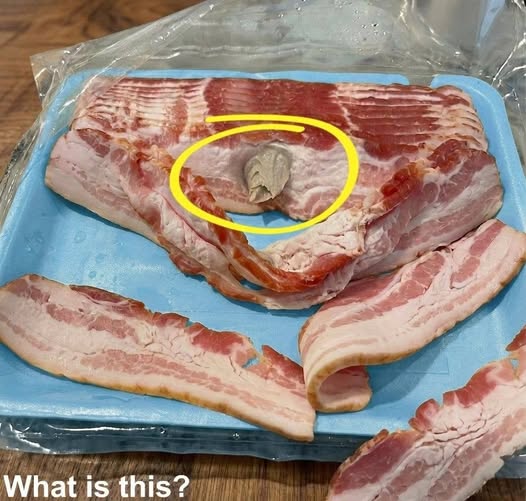
When an unusual mass is found within a cut of pork or beef, the immediate assumption by many social media commentators is that it must be a parasite or a tumor. However, agricultural scientists, veterinary pathologists, and experienced butchers point to a much more routine biological event: a localized pocket of infection, commonly referred to as a sterile or healed abscess.
In commercial swine production, animals interact closely in communal environments. Pigs are active, curious, and sometimes aggressive animals that naturally nudge, push, or occasionally scratch one another. An abscess forms when a minor puncture wound, scratch, or insect bite becomes infected with common environmental bacteria, such as Trueperella pyogenes or Staphylococcus species.
In response to this bacterial intrusion, the animal’s immune system goes into overdrive. White blood cells swarm the site of the infection to neutralize the invading pathogens. To prevent the infection from spreading to the rest of the body, the surrounding tissues wall off the affected area with a thick, fibrous capsule made of collagen. Inside this capsule, dead immune cells, bacteria, and tissue debris accumulate, forming a localized mass.
Over time, one of two things happens:
Resolution and Calcification: The animal’s immune system successfully neutralizes the bacteria. The liquid center gradually dries out, turning into a thick, paste-like, or clay-like substance. Eventually, minerals deposit into the area, causing it to harden and turn a pale grey, tan, or yellowish color.
Encapsulation: The mass remains isolated within the muscle or fat tissue, completely cut off from the rest of the animal’s circulatory system. The surrounding meat remains entirely healthy, and the animal shows no clinical signs of systemic illness.

Bacon is harvested from the belly of the pig, a region containing alternating layers of skeletal muscle and subcutaneous fat. The belly area is susceptible to minor physical trauma or injections during the animal’s early life stages (such as routine vitamin or iron supplements given to piglets). If an injection site becomes irritated or experiences a minor localized reaction, it can leave behind a small, encapsulated fibrous nodule or healed pocket deep within the fat layers. Because fat has less blood flow than muscle tissue, these small capsules can persist for long periods without being reabsorbed by the body.
A common question asked by shocked consumers is: How did this manage to get through professional inspection and end up on a grocery store shelf? To answer this, we need to examine how commercial slaughterhouses and processing plants operate. Modern food production relies on high-speed automation combined with human oversight to process thousands of pounds of meat every single hour.
In most developed nations, regulatory bodies (such as the USDA in the United States, the EFSA in Europe, or equivalent national food inspection agencies) mandate that every animal undergoes both pre-mortem (before death) and post-mortem (after death) inspections.
Ante-mortem Inspection: Veterinarians look for signs of systemic disease, lameness, fever, or distress. An animal with a visible, large, external swelling or systemic illness is immediately condemned and removed from the food supply chain.
Post-mortem Inspection: Inspectors examine internal organs, lymph nodes, and major muscle cuts for abnormalities.
However, a localized, completely internal abscess embedded deep inside a massive slab of pork belly is virtually impossible to detect from the outside. The surface of the meat may look perfectly smooth, pink, and healthy.
Once a pork belly passes visual inspection, it undergoes curing (often seasoned with salt, sugar, and nitrites) and smoking. After the curing phase, the large slabs of belly are chilled to a firm temperature so they can be fed into high-speed mechanical slicers.
These industrial slicing machines operate at incredibly high velocities, cutting hundreds of slices per minute. The sliced bacon is automatically shingled, weighed, placed onto trays, and sealed under a modified atmosphere or vacuum packaging.
Because the entire process is highly automated:
Human operators generally perform spot checks or watch the line from a distance to ensure the machinery functions correctly.
Unless an inspector or line worker happens to look down at the exact millisecond a specific slab is being cut, an internal nodule can easily pass through unnoticed.
The anomaly is only revealed when the end consumer opens the package at home and peels back the top layers of bacon, exposing the cross-section where the mechanical blade sliced cleanly through the center of the encapsulated mass.
The sight of an anomaly in food naturally triggers a disgust reflex designed to protect humans from spoiled food. However, it is essential to distinguish between a visual defect and an active health hazard.
From a strictly medical and veterinary perspective, a localized, healed, or calcified nodule in a cut of meat does not pose an immediate systemic health risk to consumers, for several key reasons:
Containment: The body’s immune response ensures that the anomaly is completely contained within its fibrous capsule. The surrounding muscle and fat tissue remain unaffected and free of contamination.
The Curing and Smoking Process: Commercial bacon undergoes a rigorous curing process involving sodium chloride (salt) and sodium nitrite. These ingredients act as potent antimicrobials, drawing out moisture and creating an environment where harmful pathogens cannot survive. Furthermore, the thermal processing (smoking/cooking) applied during manufacturing kills any residual vegetative bacterial cells.
Home Cooking: Bacon is almost universally cooked at high temperatures until crispy. Standard cooking practices expose the meat to temperatures well above the threshold required to destroy foodborne pathogens.
Even though the surrounding meat is technically safe, no food safety expert recommends eating the actual anomaly or the slices immediately touching it. The material inside the nodule has an unpleasant texture, a chalky or paste-like consistency, and a bitter flavor profile due to mineral accumulation.
Furthermore, from a quality assurance standpoint, any product containing a visible physical defect should be rejected. Consumers are fully within their rights to expect high-quality, unblemished products for their money.
When photos like this circulate on social media platforms, comment sections quickly fill with speculation, myths, and misinformation. Let us debunk some of the most common claims associated with these types of meat anomalies.
The Reality: While certain parasites can affect livestock, stringent modern farming protocols, indoor housing, controlled diets, and rigorous veterinary oversight have made large parasitic infestations extremely rare in commercial swine operations. Parasitic cysts typically display distinct structural characteristics, such as clear fluid vesicles or specific larval forms, which do not match the dense, uniform, clay-like appearance seen in the viral image.
The Reality: Neoplastic tumors can occur in all mammals, including pigs. However, the vast majority of market-weight hogs are processed at a relatively young age (typically around five to seven months). Cancerous growths are far more prevalent in older animals. When tumors do occur, they usually present with irregular margins, infiltration into surrounding muscle tissue, and a different vascular structure. A neatly rounded, self-contained mass within a fat layer is overwhelmingly indicative of an immune-mediated capsule rather than a malignancy.
The Reality: Localized physical blemishes do not mean that an entire production run or batch of meat is compromised. Because these conditions develop individually within a specific animal due to a unique minor injury or localized reaction, it is an isolated event. The rest of the packages on the supermarket shelf from the same brand are highly likely to be perfectly normal.
Discovering a visual defect in your food can be frustrating, but handling the situation calmly and systematically will ensure you get a resolution while helping manufacturers improve their quality control systems.
If you notice an unusual lump, discoloration, or foreign object while preparing your meal:
Do not cook or eat any portion of the affected package.
Keep the item inside its original packaging if possible, as the packaging contains critical tracking information.
Take clear, well-lit photographs from multiple angles. Capture the defect itself, the front of the package showing the brand name, and the back or edge of the package where the batch code, lot number, and expiration date are printed.
Supermarkets and grocery chains maintain strict customer satisfaction policies. Return the product (or bring your clear photographic evidence and digital receipt if you prefer not to transport raw meat back to the store) to the customer service desk. Retailers will almost always issue a full refund or a replacement product immediately, as they take product quality complaints seriously.
Locate the customer care contact information on the product label or visit the manufacturer’s official website. Submit your photographs along with the specific batch and lot numbers.
Why this matters: Large food brands track every customer complaint using sophisticated database systems. If multiple complaints arise from a single batch, it alerts their quality assurance team to look into a specific processing line, machine malfunction, or supplier issue. Your feedback helps them fine-tune their sorting mechanisms and prevent future occurrences.
If you feel the manufacturer is unresponsive or if you notice a recurring issue with products from the same facility, you can file a voluntary consumer complaint with your local or national food safety authority. These agencies keep records of consumer reports to monitor systemic issues within processing plants.
As technology advances, the food processing industry is actively working on solutions to eliminate human error and catch internal meat defects before they ever leave the factory floor.
Traditional visual inspection is limited to what the human eye can see on the surface of a moving conveyor belt. To overcome this limitation, progressive meat processing facilities are investing in advanced inspection technologies:
Industrial X-Ray Systems: Similar to medical X-rays, these machines scan packaged products on the production line. They can identify density differences, allowing them to detect hidden internal foreign objects, calcified nodules, or bone fragments deep within meat cuts. When an anomaly is detected, automated pneumatic arms automatically push the defective package off the line into a rejection bin.
Hyperspectral Imaging: This technology combines digital imaging with spectroscopy to analyze the chemical composition of a product slice by slice. It can instantly detect variations in moisture, fat distribution, and abnormal protein structures, flags defects that are invisible under standard lighting.
While automation is highly efficient, well-trained personnel remain an essential line of defense. Some advocacy groups argue that reducing line speeds slightly allows human inspectors more time to perform thorough visual checks on sliced products before they are sealed. Continuous training programs help plant workers recognize subtle discolorations or textural differences immediately, improving overall output quality.
Finding an unexpected, unappealing mass in a package of bacon is undeniably an unpleasant experience. It reminds us that meat is a biological product derived from living animals, rather than a synthetic commodity manufactured in a sterile laboratory.
While these occurrences can be visually jarring and disruptive to our meal plans, understanding the science behind them provides reassurance. They are typically benign, localized immune responses that pose no systemic danger to public health, escaping detection only due to the immense scale and speed of modern food processing. By documenting the issue, seeking a refund, and reporting the incident to manufacturers, consumers can actively contribute to maintaining high standards across the global food supply chain.
The Ultimate Guide to Walnuts and Longevity In the modern landscape of nutrition, superfoods frequently emerge and recede from public…
The Bacon Mystery: Uncovering What Is Really in Your Meat Introduction: The Viral Photo That Shocked Meat Lovers Social media…

An 11-year-old boy in Chongqing, China is being praised online after surviving a terrifying elevator malfunction thanks to his unusually…

The Evening Habit That Shocked Experts Small, daily routines often shape our well-being far more than sudden, drastic changes. When…
Noticing an unexpected bump on your body can cause immediate curiosity or concern. As seen in the viral post illustration…

Rats are among the most unwanted pests in many homes because they not only damage furniture, food, and electrical wires,…