
Discover Your Inner Radiance: What Does Your Favorite Nail Style Say About You?
Discover Your Inner Radiance: What Does Your Favorite Nail Style Say About You? Have you ever wondered why you gravitate…
22/05/2026 17:28
Have you ever looked closely at a quiet corner of your bedroom, garage, or hallway and noticed a bizarre, flat, teardrop-shaped pouch clinging to the brickwork? For many homeowners, discovering these small, mysterious objects can be an unsettling experience. They seem to appear out of nowhere, suspended silently on vertical surfaces, resembling a tiny piece of debris, a pumpkin seed, or a strange, dusty cocoon.
These objects are not random accumulations of dirt, nor are they a sign of structural failure. Instead, they are the mobile homes of a fascinating yet pesky insect known scientifically as Phereoeca uterella, commonly referred to as the household casebearer or the plaster bagworm.
While these creatures do not pose any direct physical danger to humans or pets, their presence can trigger anxiety and, if left unmanaged, result in minor damage to household fabrics, carpets, and storage items. Understanding what these organisms are, why they enter living spaces, and how to eliminate them efficiently is essential for maintaining a clean, comfortable, and stress-free living environment.

To understand these curious structures, it is helpful to look at the life cycle and behavior of the insect responsible for creating them. The creature inside the pouch is not a worm, but rather the larval stage of a small, inconspicuous moth species belonging to the family Tineidae. This is the same biological family that includes the notorious clothes moths that destroy fine fabrics in closets.
The most distinctive feature of this species is its ability to build a protective enclosure. Almost immediately after hatching from a microscopic egg, the young larva begins spinning a fine, strong matrix of silk. As it travels across household surfaces, it collects fragments from its immediate surroundings to reinforce and camouflage its home. These materials typically include:
Microscopic grains of sand and soil
Fine plaster dust from walls
Fallen human dander and pet hair
Tiny pieces of lint and dust bunnies
Fragmented remains of dead insects
The resulting pouch is wide and thick in the center and tapers toward both ends, remarkably resembling an elongated seed.
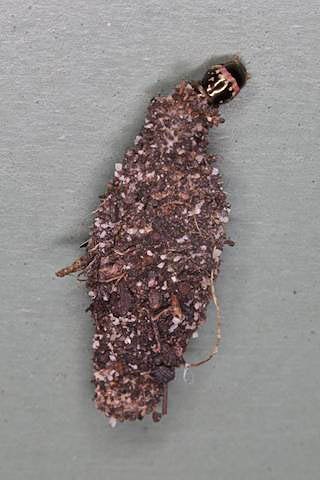
Unlike many other cocoon-building insects, the creature does not remain stationary inside its shell. The case is open at both ends. This design allows the caterpillar to extend its dark, hardened head and front legs from one side to pull its entire home forward along walls and ceilings.
If danger approaches from the front, or if the insect needs to alter its course, it can pull its body inside, turn around completely within the widened center of the pouch, and emerge from the opposite opening. This allows it to retreat or redirect its path without exposing its soft, vulnerable abdomen to predators.
The progression from a tiny egg to a flying adult moth involves four distinct stages. Recognizing these stages helps identify an infestation before it expands throughout a property.
The cycle begins when an adult female moth selects a sheltered, dark location to deposit her eggs. A single female can lay up to 200 tiny, pale-blue eggs during her brief adult life. These eggs are usually tucked into hidden crevices, rough wall textures, baseboards, or behind heavy furniture where they are safe from disturbance.
Within a couple of weeks, the larvae hatch and immediately construct their initial protective cases. This is the only phase of the insect’s life that feeds and grows. As the caterpillar increases in size, it expands the case from the inside by adding new layers of silk and external debris. The larval phase can last for several weeks or even months, depending on ambient room temperatures and the availability of food sources.
Once the larva reaches maturity—typically when the pouch reaches a length of about half an inch—it seeks out a high, secure vertical surface. It often climbs up walls to the point where the wall meets the ceiling, or hitches itself to window frames and door casings. The insect then uses tough silk strands to anchor one end of the pouch securely to the surface. It seals both openings shut from the inside and undergoes transformation into an adult moth.
After the transformation is complete, the adult moth emerges from the bottom end of the suspended pouch, leaving the empty husk behind. The adult insects are very small, with a wingspan ranging from 9 to 13 millimeters. They are dull grey or tan, with a light fringe of hairs along the margins of their hind wings. Because their mouthparts are drastically reduced or entirely non-functional, adult moths do not feed at all; their sole purpose is to find a mate, lay eggs, and perpetuate the cycle.
Finding these pouches inside a residential property usually points to specific environmental conditions that favor their survival. They are particularly common in regions characterized by warm temperatures and elevated humidity levels.
The presence of these organisms is closely tied to the accumulation of specific organic materials. Unlike other pests that target kitchen pantries, these larvae feed primarily on items rich in keratin and specialized proteins. Their favorite food sources include:
Spider Webs: The larvae frequently scavenge old, abandoned cobwebs, consuming both the structural silk and the dried, discarded parts of insects trapped within them.
Hair and Dander: Accumulations of human hair, pet fur, and shed skin cells that settle along baseboards and underneath heavy furniture provide an ongoing food supply.
Natural Textiles: If they happen to migrate into closets or storage bins, they can consume wool garments, silk fabrics, feathers, and felt materials.
These insects thrive in warm, humid air. In homes, they are most frequently spotted in areas that lack continuous air conditioning or spaces that experience naturally higher humidity levels, such as:
Attached garages and carports
Unfinished basements and crawlspaces
Laundry rooms and storage closets
Bathrooms with inadequate ventilation
When homeowners spot these strange objects dangling from their walls, the immediate reaction is often one of concern regarding hygiene, health, and property damage. Assessing the actual impact of these pests helps guide an appropriate response.
From a health perspective, these insects are completely harmless to humans and companion animals. They do not possess stingers, they do not bite, and they do not transmit pathogens or infectious diseases. Their presence is simply an aesthetic nuisance and a sign that dust or cobwebs have accumulated in nearby areas.
While walls and plaster are safe from damage—as the insects merely use the dust on surfaces to construct their shells—stored fabrics are at risk. If a significant population migrates into wardrobes, linen closets, or onto natural-fiber floor rugs, the larvae can chew small holes through valuable items.
Managing an infestation does not require aggressive or hazardous chemical treatments. Because these pests are slow-moving and rely heavily on specific structural conditions, a systematic approach centered around cleaning and physical removal is highly effective.
The most direct way to eliminate these pests is to remove the visible pouches manually.
Vacuuming: Utilize a vacuum cleaner equipped with a crevice tool or brush attachment to sweep the pouches off walls, ceilings, and baseboards. Ensure you vacuum thoroughly behind large appliances, underneath beds, and along the upper corners of closets.
Immediate Disposal: Once vacuuming is complete, empty the vacuum canister or discard the vacuum bag into an outdoor waste bin right away to prevent any trapped larvae from crawling back inside the living space.
Manual Wiping: For individual pouches found on delicate surfaces, use a damp cloth or a soft broom to gently dislodge them and drop them into a container filled with soapy water to destroy them.
Because the larvae depend heavily on spider webs and accumulated organic dust, removing these items starves out the population.
De-webbing: Regularly clear away all cobwebs from corners, light fixtures, window tracks, and garage ceilings using a long-handled duster.
Dust Control: Clean hard-to-reach floor spaces, dust beneath large furniture installations, and groom pet bedding frequently to eliminate the accumulation of hair and dander.
Altering the indoor climate makes the home far less hospitable to incoming adult moths looking to deposit eggs.
Humidity Reduction: Run a dehumidifier in naturally damp zones like basements, storage units, or crawlspaces to maintain indoor relative humidity below 50%.
Airflow Improvements: Open interior doors, utilize ceiling fans, and clear out cluttered storage rooms to maximize air circulation and eliminate stagnant, humid pockets of air.
Preventing these insects from returning to a home involves establishing a routine maintenance plan that focuses on exclusion and proper storage.
Adult moths are tiny and can drift indoors through incredibly small openings. Check window frames, exterior doors, and utility entry points for gaps or torn screens. Use high-quality caulk or weatherstripping to seal these openings completely.
When storing seasonal items made of wool, silk, or fur, avoid using simple cardboard boxes or open fabric bags, as these offer no protection against foraging larvae. Instead, opt for heavy-duty, airtight plastic storage containers with secure latches. Before placing items into long-term storage, ensure they are freshly laundered or dry-cleaned, as moths are heavily attracted to residual sweat, body oils, and faint food odors on fabrics.
To keep closets and dressing rooms smelling fresh while discouraging pests, place natural deterrents inside storage spaces. Materials like cedar blocks, cedar shavings, or small cloth sachets filled with dried lavender emit natural aromatic compounds that foraging adult moths actively avoid when searching for egg-laying sites.
Discovering unusual, seed-like pouches on interior walls can certainly feel unsettling, but it is a manageable household issue. These structures are the protective shelters of the household casebearer, a small caterpillar that builds its home out of environmental dust and silk. They are drawn to interior spaces by elevated humidity, neglected spider webs, and accumulated dander or hair.
By employing consistent vacuuming protocols, clearing out cobwebs, keeping indoor humidity levels balanced, and utilizing secure, airtight bins for natural clothing storage, you can easily eradicate these pests and keep your home clean, clear, and completely comfortable.
Discover Your Inner Radiance: What Does Your Favorite Nail Style Say About You? Have you ever wondered why you gravitate…
Most people think nail clippers are one of the simplest tools ever made. You press, clip your nails, and that’s…
The Truth Behind the Viral Social Media Post A circulating social media post claims that two specific parts of a…

The Dark Side of Fermented Sides: A Deep Dive Into Food Wellness Fermented greens have been a staple on dining…

Most people believe losing weight requires: strict dieting, intense exercise, or eating yogurt only with fruit and oats. But recently,…

The Buzz Around Wild Red Fiddlehead Ferns: Myth vs. Science Nature has always been a treasure trove of wellness resources.…