The Mystery of the Preauricular Sinus: Why Do Some People Have a Tiny Hole Near Their Ear?
The Mystery of the Preauricular Sinus: Why Do Some People Have a Tiny Hole Near Their Ear?
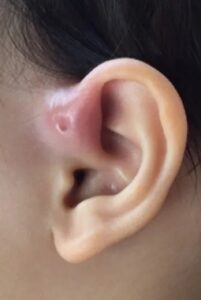
Have you ever noticed a tiny, pinprick-sized opening right where the top of someone’s ear cartilage meets their face? It is not an old piercing, a strange blackhead, or a scar from a childhood injury. If you have one—or know someone who does—you are looking at a fascinating biological feature known as a preauricular sinus.
While internet rumors and viral social media posts like to claim that the answer “might give you a slight chill,” the reality is much more grounded in embryology, genetics, and everyday anatomy.
Here is everything you need to know about these unique little features, from why they form to when they actually require medical attention.
What Exactly Is a Preauricular Sinus?
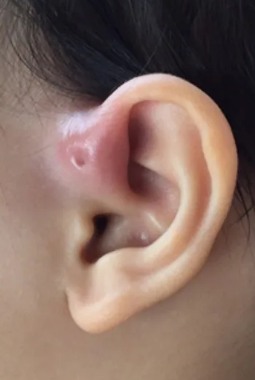
A preauricular sinus (also frequently referred to as a preauricular pit, cyst, or tract) is a congenital feature, meaning it is something a person is born with. It typically presents as a small nodule, dent, or open pit located just in front of the upper ear, near the tragus or the crus of the helix.
While it looks like a simple surface dimple on the outside, it is actually the entrance to a narrow, microscopic channel or sinus tract underneath the skin. This tract can be short and shallow, or it can branch out in complex patterns deep within the subcutaneous tissue.
Key Characteristics:
-
Location: Almost always found at the leading edge of the ear structure, where the ear meets the cheek.
-
Unilateral vs. Bilateral: It can appear on just one side (unilateral) or both sides (bilateral). Studies show it is more commonly found on the right side of the face, though bilateral presentations are also very common.
-
Prevalence: It is a relatively rare trait globally, but its frequency varies wildly depending on geographic location and ethnicity.
Why Do Some People Have Them and Others Don’t?

The presence of a preauricular pit comes down to a mix of evolutionary history, genetic inheritance, and early fetal development.
1. Fetal Development Errors
During the first few weeks of embryonic development, the structure of the human face and neck begins to take shape through specialized tissue folds called pharyngeal arches (or branchial arches).
The external ear specifically develops from six small nodules of tissue called the hillocks of His.
A preauricular sinus occurs when these hillocks fail to fuse completely during the sixth week of gestation. The incomplete fusion leaves a tiny gap, which seals over on the outside but leaves an open tract or pocket beneath the surface.
2. Evolutionary Theories (The “Fish Gill” Connection)
One of the reasons these pits capture the public imagination is a theory popularized by evolutionary biologist Neil Shubin. In his work exploring human evolutionary history, Shubin suggested that these anomalies could be an evolutionary remnant—a vestigial leftover from ancient pharyngeal slits, which eventually evolved into gills in fish.
While humans no longer have gills, our early embryonic stages still mirror the fundamental building blocks shared by many vertebrates.
3. Genetics and Inheritance
If you have a preauricular pit, there is a strong chance someone else in your family tree does too. It can be passed down through generations as an autosomal dominant trait. This means that if one parent carries the gene for the sinus tract, there is a significant likelihood their children will inherit it as well. However, it can also appear spontaneously in individuals with no family history of the condition.
Global Prevalence: Who Is Most Likely to Have It?
The likelihood of being born with this unique anatomical feature depends heavily on your ethnic background and region of origin:
| Region / Population |
Estimated Prevalence Rate |
| United States & Europe |
Less than $1\%$ (approx. $0.1\%$ to $0.9\%$) |
| Taiwan & Parts of Asia |
Around $1.6\%$ to $2.5\%$ |
| Parts of Africa |
Estimated between $4\%$ to $10\%$ |
Because it is significantly more common in certain regions of the world, many cultures view it with zero concern, treating it simply as an ordinary physical trait akin to a dimple or a birthmark.
Are They Dangerous?
The short answer is no. In the vast majority of cases, a preauricular pit is entirely benign and harmless. It is a cosmetic anomaly that does not impact a person’s hearing, balance, or general health. Most people live their entire lives with one without ever requiring medical intervention.
However, because the pit is connected to a hidden tunnel beneath the skin, it can occasionally become a hotspot for minor hygiene issues or localized health concerns.
1. Secretions and Odor
The lining of the sinus tract is made of squamous epithelium, the same type of tissue that makes up your skin. This means the inside of the tract shed dead skin cells and contains sebaceous (oil) glands.
Occasionally, a white, cheesy material can express itself from the opening. This buildup can sometimes develop an unpleasant odor due to normal skin bacteria breaking down the trapped organic material. This is completely normal and is not necessarily a sign of a medical emergency.
2. Painful Swelling and Blockages
If the narrow opening of the pit becomes blocked by dirt, oils, or dead skin cells, the secretions can build up inside the tract. This causes the area to swell up, forming a painless or mildly tender cyst underneath the skin surface.
Recognizing the Warning Signs of a Problem
While the pit itself is benign, its structure makes it susceptible to bacterial contamination. If bacteria enter the tract and become trapped, it can lead to a localized skin infection or a full-blown abscess.
You should monitor the area closely and seek medical guidance if you notice any of the following symptoms:
-
Significant Redness and Warmth: The skin surrounding the hole becomes visibly inflamed, red, and warm to the touch.
-
Progressive Swelling: A noticeable lump or nodule develops directly underneath or adjacent to the opening.
-
Severe Pain or Tenderness: The area hurts when touched, or experiences a constant throbbing pain.
-
Purulent Discharge: Yellow or green pus drains from the opening, which is distinct from the usual white, slow-moving sebaceous material.
-
Systemic Symptoms: In rare cases, a severe local infection can trigger a low-grade fever or swollen lymph nodes along the jawline and neck.
How Are Issues Diagnosed and Handled?
If a preauricular sinus never gets infected, doctors universally recommend a “leave it alone” approach. There is absolutely no reason to seek treatment for an asymptomatic pit. However, if complications arise, a medical professional will typically follow a specific, staged care plan.
Phase 1: Managing an Active Infection
If the area becomes red, painful, and swollen, a healthcare provider will address the immediate inflammation.
-
Oral Antibiotics: A standard course of targeted antibiotics is usually prescribed to eliminate the bacterial infection.
-
Warm Compresses: Applying a clean, warm compress to the area can help soothe discomfort and encourage natural drainage.
-
Incision and Drainage (I&D): If a tense, painful abscess forms and does not respond to antibiotics alone, a doctor may perform a minor in-office procedure to carefully lance and drain the fluid buildup, relieving the pressure instantly.
Important Note: Doctors will avoid performing permanent corrective surgery while the area is actively infected, as inflammation makes it difficult to clearly see the borders of the sinus tract.
Phase 2: Permanent Removal (Surgical Excision)
For individuals who suffer from recurrent, chronic infections that keep returning despite antibiotic treatment, a permanent solution may be recommended. This involves a minor surgical procedure known as a preauricular sinus excision.
-
How It Works: The surgeon removes the external pit along with the entire underlying network of microscopic channels. To ensure no microscopic pathways are left behind (which could cause the issue to return), surgeons often inject a special blue dye into the opening before the procedure to clearly map out the entire tract.
-
Anesthesia: Depending on the patient’s age and the complexity of the tract, the procedure can be performed under local anesthesia (numbing the specific area) or general anesthesia.
-
Recovery: The recovery period is typically quick, with minimal scarring that fades into the natural crease of the ear over time.
Best Practices for Everyday Care
If you or your child has a preauricular pit, practicing good everyday hygiene is the best way to prevent blockages and reduce the risk of irritation.
-
Keep It Clean: Wash the area gently during your normal shower routine with mild soap and warm water.
-
Do Not Poke or Prod: Avoid sticking objects like cotton swabs, pins, or jewelry into the hole to clean it out. Pushing objects into the tract can damage the delicate lining or force surface bacteria deep into the channel.
-
Avoid Squeezing: If you notice a tiny amount of white material at the opening, resist the urge to squeeze it like a pimple. Squeezing can rupture the internal tract walls, causing deeper irritation or triggering an infection.
-
Be Mindful of Hair Products: When applying heavy hair oils, styling gels, or thick face creams, try to keep them away from the immediate area surrounding the pit to prevent accidental clogging.
When to Consult a Specialist
In a small minority of cases, a preauricular pit can be associated with broader developmental conditions. If a newborn baby is found to have preauricular pits alongside other physical traits—such as structural abnormalities of the external ear, asymmetry of the face, or issues with kidney function—a pediatrician may recommend further screening.
Conditions like Branchio-Oto-Renal (BOR) syndrome are rare genetic disorders that affect the development of the ears, neck tissue, and kidneys. If a doctor suspects a broader pattern, they may order a routine ultrasound of the kidneys or a standard hearing test to ensure everything is developing perfectly. For an isolated pit with no other symptoms, these additional screenings are generally not necessary.
Final Thoughts: A Unique Biological Stamp
The internet loves to sensationalize minor anatomical quirks, turning harmless physical traits into scary or ominous warnings. But despite the dramatic captions floating around social media, a small hole next to the ear is nothing to lose sleep over.
It isn’t dangerous, it isn’t a medical emergency, and it certainly shouldn’t give you a chill. It is simply a tiny, unique marker of our complex biological development—a personal stamp of embryological history left right at the edge of your smile. As long as it remains calm, clean, and pain-free, it is simply another beautiful quirk that makes human anatomy so fascinatingly diverse.