
The Hidden Tick Parents Often Miss in Their Child’s Hair
The Hidden Tick Parents Often Miss in Their Child’s Hair Finding a strange insect in your child’s hair can instantly…
22/05/2026 15:08
When you stroll down the dairy aisle of your local supermarket, you are greeted by an abundance of choices. You will see rows of classic white and brown chicken eggs, rich and large duck eggs, and perhaps even tiny, speckled quail eggs. Yet, there is one massive poultry staple that is glaringly absent from the shelves: the turkey egg.
Given that turkey meat is incredibly popular globally, it seems highly unusual that their eggs are nowhere to be found. Is there a hidden health risk? Are they unsafe for human consumption? The internet often spins wild theories around this topic, but the truth is grounded entirely in agricultural history and basic economics.
Here is the complete, untold story of why turkey eggs never made it to your breakfast plate.
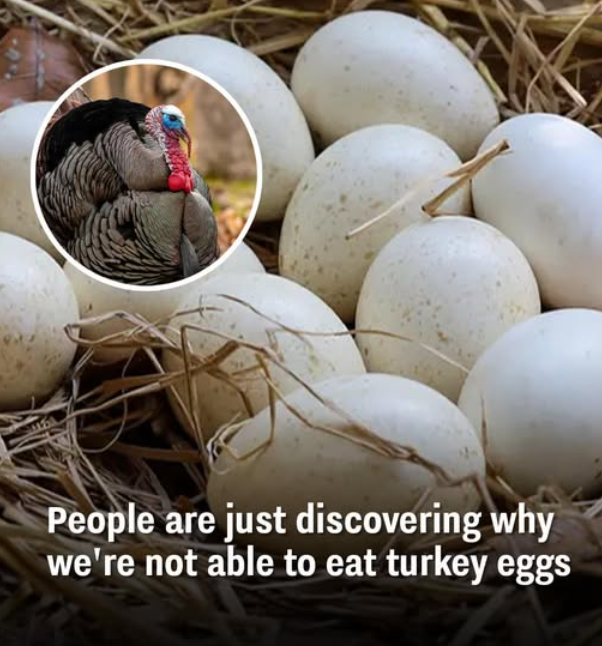
Before diving into the economic factors, let us clear up the single biggest misconception: turkey eggs are completely safe, edible, and highly nutritious. There is absolutely nothing toxic or dangerous about them. In fact, those who have tried them often report that they are downright delicious.
If you were to crack open a turkey egg for breakfast, you would find it remarkably similar to a standard chicken egg, but with a few luxurious upgrades:
Richer Flavor: The yolk-to-white ratio in a turkey egg is much higher than in a chicken egg. This results in a significantly creamier, richer, and more savory flavor profile.
Texture: Due to the dense nutrient structure, they offer a velvety texture that makes them excellent for baking and creating fluffy omelets.
Size and Structure: A single turkey egg is roughly $50\%$ larger than a large chicken egg. They feature a distinctly pointed shape, a beautiful speckled shell, and a much thicker internal membrane.

From a health perspective, these eggs are a powerhouse. Because of their size and dense yolks, they pack a major nutritional punch compared to standard poultry options.
| Nutrient Profile | Average Chicken Egg (Large) | Average Turkey Egg |
| Weight | ~50 grams | ~79 grams |
| Calories | 72 kcal | 135 kcal |
| Protein | 6.3 grams | 10.8 grams |
| Total Fat | 4.8 grams | 9.4 grams |
| Cholesterol | 186 mg | 737 mg |
Note: While they offer excellent amounts of protein, iron, and essential vitamins, their exceptionally high cholesterol content means they might not be the ideal choice for everyday consumption if you are monitoring your daily lipid intake.
If they taste great and are packed with nutrients, why aren’t commercial farms producing them? The primary answer lies in production volume. High-volume output is essential for keeping grocery prices low, and this is where the turkey falls incredibly short compared to the humble chicken.
The modern domestic chicken is an absolute marvel of selective breeding. A healthy commercial laying hen can produce between 250 to 300 eggs per year. Essentially, they lay almost every single day.
In stark contrast, a domestic turkey hen lays an average of only 100 to 110 eggs per year. Furthermore, turkeys do not lay consistently year-round; their reproductive cycle is highly seasonal, meaning they primarily lay during the spring months. For a commercial producer, a bird that goes off-duty for half the year is a major financial risk.

Time is money in agriculture. A chicken matures rapidly and begins its production cycle at around 5 months of age. A turkey requires much more patience, taking at least 7 to 8 months before producing its very first egg. Farmers must pay to feed and shelter a turkey for several additional months before seeing any return on their investment.
To understand why a product isn’t on store shelves, you must look at the expenses incurred behind the scenes. Raising a bird that weighs 15 to 30 pounds requires vastly more resources than raising a bird that weighs only 3 to 5 pounds.
[Resource Requirements Comparison]

Chicken:
 Low Feed Consumption | Small Housing Footprint | Lightweight Infrastructure

Turkey:
 High Feed Consumption | Massive Housing Space   | Heavy-Duty Infrastructure
Turkeys have massive appetites. To sustain their body mass and support their reproductive systems, they require specialized, high-protein feed in large quantities. Because they consume significantly more feed per day while producing less than half the output of a chicken, the financial calculations simply do not align for business owners.
Due to their sheer physical size, turkeys cannot be kept in standard poultry facilities. They require:
Substantially more square footage per bird to move comfortably.
Much taller, heavier-duty fencing and housing structures to contain them.
Substantial open-air space, which increases land acquisition and maintenance costs.
Every animal on a farm has a specific primary purpose that maximizes its financial value. For the turkey, that purpose is meat production.
Because turkeys grow so large, they are incredibly valuable when sold as whole birds or processed deli meats, especially during major autumn holiday seasons.
        ┌───────────────────────────────┐
        │     One Female Turkey         │
        └──────────────┬────────────────┘
                       │
         Can be utilized in two ways:
                       │
        ┌──────────────┴──────────────┐
        │                             │
▼       ▼                             ▼       ▼
[Option A: Sell 100 Eggs]             [Option B: Hatch 100 Chicks]
Low market demand.                    Grow into 100 full-sized birds.
Minimal financial return.             Massive wholesale meat revenue.
If a farmer sells a turkey’s egg for consumption, that egg is gone forever. However, if the farmer allows that egg to hatch, it becomes a new chick (poult). That poult can be raised for a few months and sold as a massive source of high-quality protein, yielding a far superior profit margin. Economically, using a fertile turkey egg for breakfast is considered a waste of potential revenue.
When you combine low production numbers, high feed costs, extensive space requirements, and a long maturity cycle, the retail price skyrockets.
If a grocery store were to stock commercial turkey eggs today, a single dozen would likely retail for anywhere between $35.00 to $40.00.
At that price point, they cease to be a breakfast staple and instead become an ultra-luxury novelty item. The vast majority of everyday shoppers would simply opt for a $3.00 carton of chicken eggs instead.
If your curiosity is piqued and you still wish to try one, you will need to bypass traditional supermarkets entirely. They are occasionally available if you know where to look:
Local Homesteaders: Small-scale, independent farms or backyard hobbyists who keep heritage poultry breeds often have excess unfertilized eggs available.
Farmers Markets: Specialized seasonal agricultural markets sometimes feature vendors offering alternative poultry products during the spring laying season.
Specialty Craft Producers: Local heritage turkey breeders may sell non-incubated options directly to consumers upon request.
Ultimately, the lack of turkey eggs on supermarket shelves isn’t a matter of safety or quality. It is a perfect demonstration of modern food production efficiency. The chicken remains the undisputed champion of the breakfast table simply because it delivers maximum nutrition at a price point that keeps household budgets balanced.
The Hidden Tick Parents Often Miss in Their Child’s Hair Finding a strange insect in your child’s hair can instantly…

When you stroll down the dairy aisle of your local supermarket, you are greeted by an abundance of choices. You…

Imagine stepping into your sanctuary for a warm, relaxing shower, only to look down and find a scene straight out…

Spot the Hidden Truth Behind Your Personality Traits Optical illusions have fascinated humanity for centuries, serving as a captivating bridge…

Your Tongue Health and What It Reveals About Your Body Discover what a map-like pattern on your tongue really means…

Are you ready to give your mind a quick, fun workout? Visual puzzles and brain teasers have taken the internet…