Rescue Dog Leaves A Life Of Fear And Starts Learning Love
When a rescue dog first arrives in a safe place after a life of neglect, the quiet moments often tell the most powerful story. A recently shared video of George, a rescued dog now in the care of Happy Doggo in Thailand, captures that fragile turning point when fear begins to loosen its grip and a world full of love starts to feel real. This early stage of a rescue dog’s journey is where healing begins, and George’s story offers a moving look at what it takes to help a traumatized animal trust again.
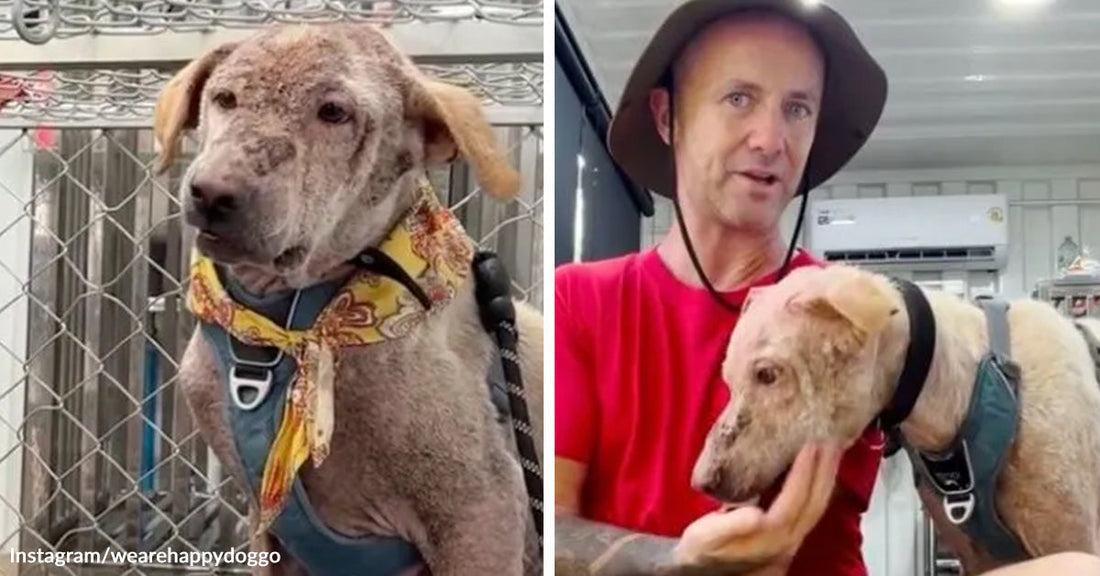
Many rescue organizations know that the first days after bringing in a dog from difficult conditions are critical. Animals accustomed to pain, deprivation, or uncertainty often arrive in a heightened state of stress. They may shut down, avoid eye contact, or react to every movement as if it could bring harm. In George’s case, the video shared on Instagram by @wearehappydoggo shows a dog who has clearly survived a long history of neglect. His body language, his skin condition, and even the way he holds himself reveal how much he has endured.
According to the post, George spent much of his life surrounded by pain and neglect before he was finally taken in by Happy Doggo, a rescue founded by Niall Harbison. The footage begins with a look at George just ten days earlier. His skin appears sore and inflamed, the sort of prolonged medical issue that does not develop overnight. It is a visible reminder of a life where his basic needs were not met. Yet the most striking detail is not only his physical state but his wariness around people, a hallmark of a rescue dog living in fear.
In those early scenes, George seems guarded and unsure. He reacts carefully to the shelter staff, as though every interaction might come with a cost. The video suggests that even simple gestures, like someone reaching out a hand, feel overwhelming to him. This is a common response for animals who have learned that humans are unpredictable or even dangerous. The confusion on George’s face reflects a dog who does not yet understand that help has arrived, that the rules of his world have changed.
Over time, however, the tone of the video begins to shift. Later clips show Harbison sitting with George, offering gentle presence instead of pressure. Treats become a quiet invitation, a way to bridge the gap between fear and curiosity. George does not transform overnight, but he starts to engage. He accepts the food. He remains close instead of pulling away. Eventually, he allows himself to be petted, a small yet meaningful sign that his defenses are beginning to relax.
These moments might seem ordinary with a well-adjusted pet. Within the context of trauma recovery, they are milestones. A hesitant tail wag, a choice to sit near a person, a willingness to take a treat from a human hand all show progress. They indicate that George is testing the possibility that this new environment is different, that these people might be safe. I found this detail striking because it illustrates how trust is not a single decision but a series of tiny, hopeful experiments.
Another part of the video shows George outdoors, an important step for many rescue dogs healing from neglect. Under natural light and open skies, he moves more freely. His posture appears looser. The way he carries himself has changed from tightly wound vigilance to something closer to relaxation. His tongue hangs out in what looks like a carefree expression, the kind many dog guardians recognize as a sign of genuine happiness. Even without words, his body seems to say that he is beginning to feel a little more at ease in his new life.
Although George’s physical recovery is still clearly a work in progress, the emotional shift is already visible. The caption accompanying the video reflects this transformation. It notes that while his skin needs time to heal, “the light is back in his eyes.” That single line captures the heart of his journey so far. Physical injuries can be treated with medicine, good nutrition, and proper care. Emotional wounds take patience, consistency, and a kind of gentle persistence that animals can slowly learn to trust.
The caption also points out that only days before, George was overwhelmed by fear and unable to comprehend that the people around him were there to help. From his perspective, every past experience may have warned him to expect harm instead of kindness. Now, in a relatively short period, he is starting to accept care and affection. Those watching can see him shift from simply enduring contact to cautiously seeking it. For many in animal rescue, this is one of the most rewarding transitions to witness, because it signals that the dog is beginning to reclaim a sense of safety.
Scenes like these highlight why early rehabilitation for neglected animals is both delicate and vital. Rescue dogs often need more than food, shelter, and veterinary treatment. They need predictable routines, calm voices, and interactions that respect their boundaries. George’s journey shows what can happen when a dog in crisis is met with that kind of patient, compassionate support. Instead of being pushed to “get over it,” he is allowed to move forward at his own pace, which supports a deeper and more lasting form of healing.
The video of George also serves as a reminder that progress is not always dramatic. Sometimes it looks like a dog who no longer flinches when a hand approaches, who chooses to lie down near a person instead of in the corner of a kennel, or who discovers joy in something as simple as feeling the sun on sore skin. Those watching his story unfold can see that even small steps are meaningful, especially for an animal coming from a history of pain.
The post closes with a reassuring message directed at George: “We’ve got you, George.” It is a short sentence, but it encapsulates the new reality surrounding him. Where there was once instability, there is now a commitment to his well-being. Where there was fear, there is now the chance to experience stability and care. For George, and for many dogs like him, that promise is the beginning of a world where love and safety are no longer exceptions, but the new normal.