
Which Couple Seems the Happiest? Decode Your True Self
Which Couple Seems the Happiest? Decode Your True Self Have you ever looked at a passing crowd on a rainy…
23/05/2026 17:01
Viral Math Problem Solved: Is It Really 6?
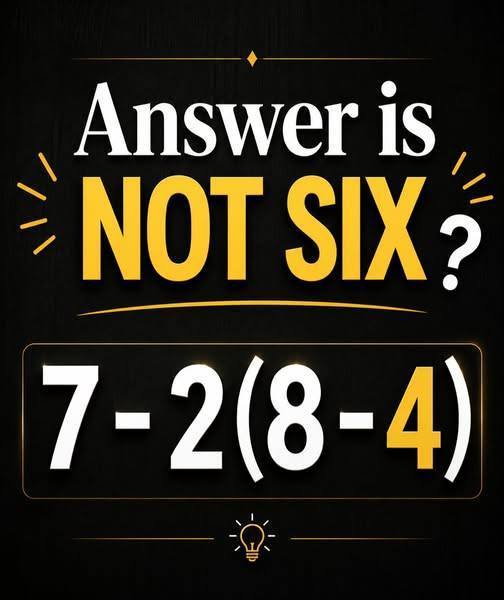
The internet is once again divided over a seemingly simple math problem. You have probably seen the image floating around social media with a bold headline claiming: “Answer is NOT SIX?” The equation in question is:
At first glance, it looks like elementary school math. Yet, thousands of smart people are arguing in comment sections, doubting their own teachers, and falling into a clever psychological trap.
So, what is the actual correct answer? Why does everyone keep getting 6 or -1? More importantly, is the viral image lying to you just to get engagement? Let’s break down the math step-by-step using standard arithmetic rules to find the definitive solution.

When people look at $7 – 2(8 – 4)$, they usually split into two main camps based on how they process the order of operations.
Some people read mathematical expressions strictly from left to right without considering operational hierarchy. They see $7 – 2$ first, subtract it to get $5$, then multiply by the result of the parentheses $(4)$, leading them to an answer of $20$. This is universally recognized as incorrect by modern algebraic standards.
This is the most common trap. People remember that they need to do parentheses first, but then they make a critical error in subtraction.
They solve $(8 – 4) = 4$.
They look at the expression as $7 – 2 \times 4$.
However, instead of multiplying first, their eyes are drawn to the $7 – 2$ part again, or they subtract incorrectly, somehow landing exactly on positive $6$.
Let’s look at the correct mathematical framework to see why these errors happen and how to avoid them.
To solve any expression with multiple operations, mathematicians use a standardized order of operations. Depending on where you went to school, you might know this acronym as PEMDAS or BODMAS:
| Acronym | Meaning | Priority Level |
| P / B | Parentheses / Brackets | Highest Priority (Do First) |
| E / O | Exponents / Orders (Powers, Roots) | Second Priority |
| M / D | Multiplication and Division | Third Priority (Left to Right) |
| A / S | Addition and Subtraction | Lowest Priority (Left to Right) |
Now, let’s apply these exact rules to our viral equation.
The rule states we must evaluate everything inside the brackets or parentheses before doing anything else.
Now substitute this back into the original formula:
When a number is directly next to a parenthesis with no symbol between them, it signifies multiplication. The expression can be rewritten as:
According to PEMDAS/BODMAS, multiplication has a higher priority than subtraction. Therefore, we must multiply $2$ by $4$ before touching the number $7$.
Now substitute the product back into our expression:
When you subtract a larger number from a smaller number, the result goes into negative territory:
The mathematically objective, absolute answer is $-1$.
The viral image states: “Answer is NOT SIX?” > The Reality Check: The image is absolutely correct in this statement—the answer is indeed NOT six. The answer is $-1$.
However, page creators use a specific layout trick on social networks to maximize interaction rates. By phrasing it as a provocative question (Is the answer really NOT 6? Find out in the comments), they trigger a psychological response in users:
The Confident Complacency: Users who quickly skim the problem mistakenly calculate $6$ or $20$ in their heads.
The Outrage Factor: Seeing an image assertively tell them their quick mental math is wrong frustrates them.
The Engagement Loop: Outraged users click on the comment section to argue, write out their incorrect explanations, or debate with others.
Every single comment, share, and long click boosts the post inside social algorithms, making it go even more viral. It is a masterclass in engagement optimization using basic arithmetic.
This viral problem highlights why so many people struggle with mental math in everyday scenarios, such as calculating discounts, split bills, or construction measurements. Here are the major takeaways to keep your math sharp:
Parentheses Rule All: Always clear out grouped numbers first.
Don’t Just Read Left to Right: Text is read left to right, but mathematical logic is hierarchical. Multiplication and division are structural anchors that must be resolved before basic addition and subtraction.
Watch Your Negative Signs: A very common mistake is treating $-2(4)$ as just $2 \times 4$ and forgetting that the minus sign applies to the final step, changing $7 – 8$ into a negative outcome.
The next time you see a math puzzle clogging up your social media timeline, remember to slow down, write out the PEMDAS steps, and avoid falling for the engagement traps. The numbers never lie, even if online headlines try to confuse you!
Which Couple Seems the Happiest? Decode Your True Self Have you ever looked at a passing crowd on a rainy…

Why Boiled Eggs are the Ultimate Breakfast Choice Are you looking for a simple, budget-friendly way to upgrade your morning…

Master the Ultimate Soil Hydration Techniques to Keep Your Pepper Plants Vibrantly Green and Packed with Fruits All Season Long…

No matter how luxurious, highly rated, or pristine a hotel appears, every room hosts a high volume of human turnover.…

In recent years, unusual stories shared online have captured massive attention across social media platforms. Among them, one topic continues…

The internet is filled with unusual discoveries, but every once in a while, a single image captures global curiosity in…