Is putting used tissues on a plate impolite, or does it make it easier for the restaurant to clear tables?
The debate over where to leave used tissues or napkins at a restaurant table is as old as dining itself. While well-meaning guests often toss their crumpled tissues onto an empty plate or bowl—thinking they are helping the waitstaff clear the table efficiently—this seemingly thoughtful gesture often achieves the exact opposite result.
From a professional service standpoint, placing used personal hygiene items onto tableware creates significant logistical, sanitary, and aesthetic issues. To truly understand why this practice is generally discouraged, one must look at the hidden mechanics of restaurant operations, the psychological impact on surrounding diners, and the universal rules of modern dining etiquette.
1. The Good Intentions Behind the Action
Most people who place used tissues into bowls or onto plates do so with the best of intentions. The thought process is simple and logical on the surface:
-
Consolidation: By gathering all the waste—food scraps, wrappers, and tissues—into one single container, the diner feels they are creating a neat “package” for the busser.
-
Preventing Mess: Keeping a soiled tissue on a plate seems preferable to leaving it directly on the wooden table or tablecloth, where it might leave a damp spot or blow away.
-
Efficiency: It appears to save the server from making multiple movements to pick up loose items.
While the intent is rooted in courtesy, the execution fails to account for how restaurants actually manage waste behind the scenes.
2. Why It Makes Clearing Tables Harder
The primary misconception is that everything on a plate goes into the same place. In reality, modern commercial kitchens utilize highly organized sorting and cleaning systems. Mixing personal paper waste with food waste disrupts this entire workflow.
The Problem of Waste Separation
Most food establishments separate organic food waste from dry trash. Food scraps often go into specific compost bins or specialized disposal systems. Tissues, napkins, and wet wipes, however, must go into general landfill trash.
When a guest buries a crumpled, wet tissue inside a bowl or sticks it to a plate covered in sauce, the waitstaff must manually separate them. A busser cannot simply scrape the plate into the food waste bin; they now have to fish out the sticky, sauce-soaked paper by hand or using tongs, which significantly slows down their pace during a busy rush.
The “Soggy Mess” Factor

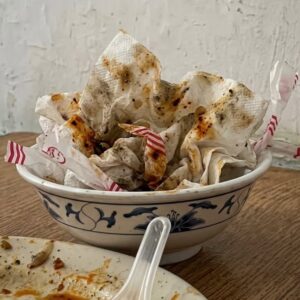
As seen in the visual example, tissues are highly absorbent. When placed into a bowl that still contains residual broth, oil, or sauce, the tissue acts like a sponge. It absorbs the remaining liquids and transforms into a heavy, dripping, unhygienic mass.
When a server attempts to stack these plates or bowls to carry them back to the kitchen, the soggy tissues risk dripping onto the server’s hands, clothes, or even onto the floor of the dining room. Furthermore, trying to stack bowls that are stuffed with bulky paper waste makes the stack unstable, increasing the likelihood of accidental spills and broken dishes.
Dishwasher Complications
In fast-paced environments, plates are often loaded directly into commercial dishwashing racks after a quick scrape. If a small piece of a disintegrated, wet tissue adheres to the side of a bowl and goes unnoticed, it can bypass the scraping phase. Once inside the high-pressure commercial dishwasher, the paper breaks down into tiny fibers that can clog the machine’s filtration system or stick to other clean dishes, requiring the entire load to be washed again.
3. The Sanitation and Hygiene Perspective
Beyond the mechanical difficulties of washing dishes, there is a fundamental health and safety concern. Tissues are inherently personal hygiene products. Unlike standard table napkins used to wipe food from the lips, tissues are frequently used to blow noses, wipe sweat, or catch coughs.
| Aspect |
Table Napkin |
Personal Tissue |
| Primary Use |
Wiping food, oil, and grease from lips/hands. |
Wiping sweat, blowing nose, catching coughs. |
| Bacterial Risk |
Low to Moderate (mainly food-borne particles). |
High (respiratory droplets, bodily fluids). |
| Staff Handling |
Expected part of restaurant textile management. |
Avoided due to direct cross-contamination risks. |
When these items are placed on tableware, they contaminate surfaces that must be thoroughly sanitized later. More importantly, it forces the service staff to come into direct physical contact with potential pathogens. In an industry where health regulations are strict, minimizing staff exposure to bodily fluids is a top priority. A gesture intended to be helpful instead forces a hospitality worker to handle someone else’s biological waste.
4. The Dining Room Atmosphere and Aesthetics
Restaurants sell an experience, not just food. A crucial component of that experience is visual comfort. The sight of a heavily soiled, sauce-stained tissue piled high in a bowl can instantly ruin the appetite of neighboring tables.
Dining spaces are shared environments. If an individual finishes their meal early and leaves a mountain of crumpled, stained tissues in plain sight, anyone sitting across from them or at an adjacent table is forced to look at it. It degrades the visual appeal of the space and transforms a pleasant dining area into an unappealing cleanup zone before the meal is even fully concluded.
5. What International Etiquette Guidelines Say
Traditional and modern etiquette standards across the globe are remarkably aligned on this issue: keep personal waste off the tableware.
-
Western Dining Etiquette: Standard protocols dictate that cloth napkins should be loosely folded and placed to the left of the plate (or on the chair if stepping away temporarily) at the end of the meal. Paper napkins can be placed lightly on the plate only if they are clean or minimally used, but personal tissues should never be placed there.
-
Eastern Dining Traditions: In many Asian cultures, especially in casual dining settings where individual tissue boxes are provided at the table, guests are expected to dispose of their own tissues in small trash bins located beneath or next to the table. If no bin is available, leaving them discretely tucked under the edge of a plate or keeping them in one’s pocket until a trash can is found is preferred over tossing them into a shared soup bowl.
6. Best Practices: How to Actually Help the Staff
If putting tissues on the plate is a mistake, what should a considerate diner do instead? There are several highly effective alternatives that genuinely make a server’s job easier while keeping the environment sanitary.
Use the Designated Waste Bins
Many casual eateries, barbecue spots, and street-food style establishments provide small plastic trash baskets specifically for wrappers, skewers, and tissues. Always utilize these bins first.
Keep It to the Side
If no trash bin is available, the best approach is to fold the used tissue neatly (keeping the soiled parts hidden on the inside) and place it on the table surface next to your plate, or under the edge of the plate so it doesn’t blow away. This allows the server to clear the heavy tableware safely first, and then sweep the dry paper waste directly into a trash bin at the end of the process.
Take It With You
If you have used a tissue to blow your nose heavily, the most polite action is to fold it up, place it in your pocket or bag, and dispose of it in a proper restroom trash receptacle. This completely removes the burden of handling personal biological waste from the restaurant staff.
7. A Universal Summary for Diners
The golden rule of restaurant courtesy is to separate the things you eat from the things you use for personal hygiene. While consolidating waste feels like an act of organization, the operational reality of commercial kitchens makes it a hindrance.
By keeping your used tissues off the plates and bowls, you protect the health of the staff, maintain a beautiful environment for fellow diners, and truly assist the team in keeping operations running smoothly.